Each year, the IRS adjusts federal tax figures to keep pace with inflation, and the 2027 numbers are now out. Alongside updates to income tax brackets, standard deductions, gifting, and estate exemptions, several retirement contribution and health savings limits are changing. These changes may not alter your plans, but understanding them can support more informed decisions as the year closes and as you look ahead.
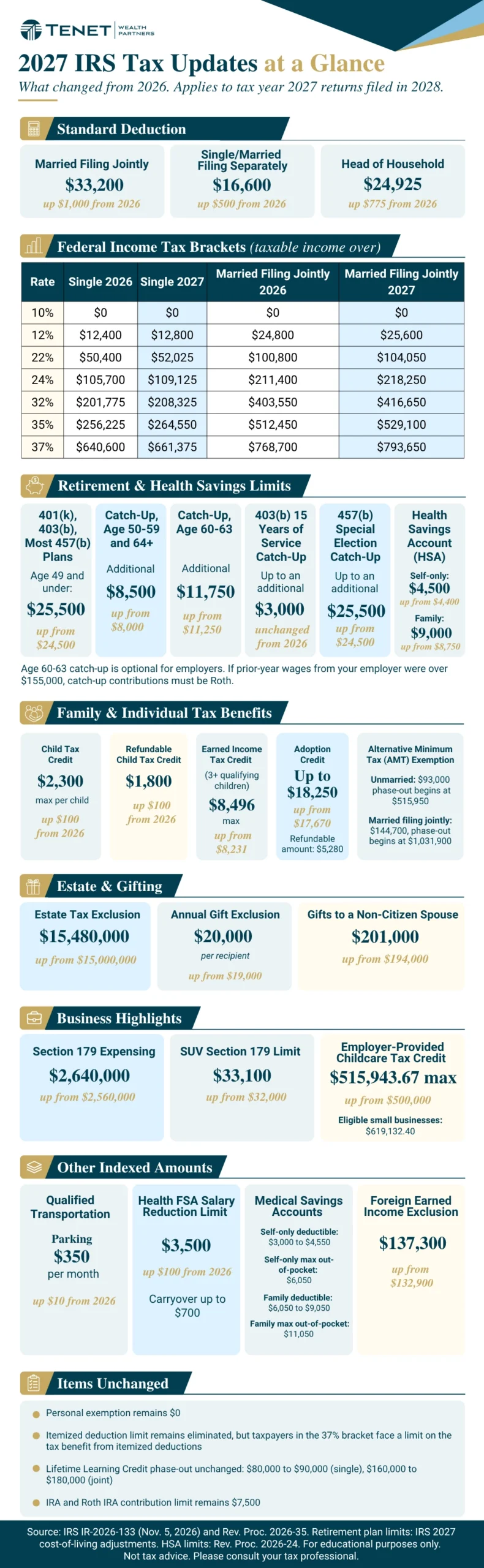
Federal Income Tax Brackets: Higher Thresholds for 2027
The seven federal tax rates, from 10% to 37%, stay the same. What changed is where each rate begins. For 2027, the thresholds are higher in every bracket, for both single filers and married couples filing jointly.
These thresholds apply to taxable income, which is what remains after deductions, not your total earnings. The system is also progressive: only the portion of income that falls within a bracket is taxed at that bracket’s rate. Moving into a higher bracket does not mean all of your income is taxed at the higher rate.
Because the thresholds moved up, more income may fall into lower brackets than it would have under the 2026 figures. The effect will depend on individual circumstances.
Federal Income Tax Brackets (taxable income over)
| Rate | Single 2026 | Single 2027 | Married Filing Jointly 2026 | Married Filing Jointly 2027 |
| 10% | $0 | $0 | $0 | $0 |
| 12% | $12,400 | $12,800 | $24,800 | $25,600 |
| 22% | $50,400 | $52,025 | $100,800 | $104,050 |
| 24% | $105,700 | $109,125 | $211,400 | $218,250 |
| 32% | $201,775 | $208,325 | $403,550 | $416,650 |
| 35% | $256,225 | $264,550 | $512,450 | $529,100 |
| 37% | $640,600 | $661,375 | $768,700 | $793,650 |
The Standard Deduction Increases Across Filing Statuses
The standard deduction is a fixed amount that reduces the income subject to federal tax. Many taxpayers claim it rather than itemizing their deductions. The 2027 amounts are higher for each filing status shown below.
A larger standard deduction may reduce taxable income for those who claim it, but the benefit will not be the same for everyone, particularly for households that itemize.
Standard Deduction
| Filing status | 2026 | 2027 |
| Single | $16,100 | $16,600 |
| Married Filing Jointly | $32,200 | $33,200 |
| Head of Household | $24,150 | $24,925 |
Gifting and Estate Planning: Updated Exclusion and Exemption
The annual gift exclusion is a per-person amount that can generally be given each year without counting against a donor’s lifetime exemption. It is not a strict cap on generosity. Gifts above that amount do not automatically result in tax owed, though they may count toward the lifetime exemption and could involve reporting requirements.
The estate and lifetime gift exemption is the total value an individual may generally transfer, during life or at death, before federal estate or gift tax may apply. It is not a guaranteed tax-free benefit for every person, and it will not be a concern for every family.
For families thinking about wealth transfer, these figures can help frame conversations about gifting, beneficiaries, and how an estate plan is structured. That does not mean everyone needs to make changes.
Gift and Estate
| Item | 2026 | 2027 |
| Annual gift exclusion (per person) | $19,000 | $20,000 |
| Estate and lifetime gift exemption | $15,000,000 | $15,480,000 |
2027 Retirement and Health Savings Limits
Several retirement and health savings limits are also increasing for 2027. The key figures below show what is changing and what is staying the same.
- 401(k), 403(b), and most 457(b) plans: The basic annual deferral limit for those age 49 and under rises to $25,500, up from $24,500 in 2026.
- Age-based catch-up contributions: Eligible participants ages 50–59 and 64 or older can contribute an additional $8,500, up from $8,000. For those ages 60–63, the higher catch-up limit is an additional $11,750, up from $11,250. The 60–63 catch-up is optional for employers, so check whether your workplace retirement plan offers it. If your prior-year Social Security wages from the employer sponsoring your plan were over $155,000, all catch-up contributions must be made as Roth contributions.
- Special plan catch-ups: The 403(b) catch-up for eligible participants with 15 years of service remains up to an additional $3,000. The 457(b) special election catch-up rises to up to an additional $25,500, from $24,500. These provisions have separate eligibility and plan rules; the 457(b) special catch-up cannot be combined with an age-based catch-up in the same year. The age 50+ catch-up for 457(b) plans is available only in governmental plans.
- Traditional and Roth IRAs: The basic annual contribution limit remains $7,500. This is a combined limit across traditional and Roth IRAs, rather than a separate allowance for each.
- Health savings accounts (HSAs): The annual limit rises to $4,500 for self-only coverage, up from $4,400, and $9,000 for family coverage, up from $8,750.
- Health flexible spending arrangements (FSAs): The annual employee salary reduction contribution limit increases to $3,500, up $100 from 2026.
For eligible savers, higher limits may mean more room to contribute to a workplace retirement plan or set aside money for health expenses in 2027. The amount available depends on factors such as age, coverage, eligibility, and the rules of the plan.
Planning Considerations for Year-End and Beyond
Year-end is a natural time to revisit your plan. Higher thresholds and deductions may affect how you think about income and gifting, while higher retirement contribution and health savings limits may create additional room to save for eligible households. The updated gift and estate figures may also be worth a fresh look alongside your current estate documents and beneficiary designations. How these changes fit together depends on your circumstances, and your tax professional and attorney remain important partners.
As you review your year-end plans, the Tenet Wealth Partners team can help you consider how these updates fit into your broader financial picture.
Sources: IRS IR-2026-133 (Nov. 5, 2026) and Rev. Proc. 2026-35; IRS 2027 retirement plan cost-of-living adjustments; IRS Rev. Proc. 2026-24 (HSA limits). For informational purposes only. Not tax advice. Please consult your tax professional.
Make Year-End Tax Planning Part of Your Financial Plan
No pressure. Just a conversation about your financial plan.

Investment advisory services offered through Tenet Wealth Partners, LLC, a registered investment advisor with the U.S. Securities and Exchange Commission. This material is intended for informational purposes only. It should not be construed as legal or tax advice and is not intended to replace the advice of a qualified attorney or tax advisor. This information is not an offer or a solicitation to buy or sell securities. The information contained may have been compiled from third-party sources and is believed to be reliable.
The information provided in this communication was sourced by Tenet Wealth Partners through public information and public channels and is in no way proprietary to Tenet Wealth Partners, nor is the information provided Tenet Wealth Partner’s position, recommendation or investment advice.
This material is provided for informational/educational purposes only. This material is not intended to constitute legal, tax, investment or financial advice. Investments are subject to risk, including but not limited to market and interest rate fluctuations.
Any performance data represents past performance which is no guarantee of future results. Prices/yields/figures mentioned herein are as of the date noted unless indicated otherwise. All figures subject to market fluctuation and change. Additional information available upon request.
About The Author
Kevan Melchiorre, CFP®Co-Founder & Managing Partner
Kevan Melchiorre co-founded Tenet Wealth Partners in 2021 with a focus on delivering a premier client experience, supported by an innovative and fully integrated approach to wealth planning. As a CERTIFIED FINANCIAL PLANNER® practitioner with over 18 years of wealth management experience, Kevan partners with affluent individuals, families, and institutions to help align their capital […]
Learn more about Kevan