

When most people think about investing, they focus on what they own: stocks, bonds, mutual funds, and the role each plays in building and preserving wealth.
There is another question that often gets less attention: Where are those investments held?
If you have a workplace retirement plan, an IRA, a Roth account, and a taxable brokerage account, each one follows its own set of tax rules. The same investment can be taxed differently depending on which account it sits in, and that can affect how much of your return you ultimately keep.
This is the idea behind asset location: deciding which investments to hold in taxable, tax-deferred, and tax-free accounts based on how those investments are taxed.
It is related to, but different from, asset allocation. Asset allocation is how your portfolio is divided among investments such as stocks and bonds. Asset location looks at where those investments are held.
For individuals and families with several types of accounts, understanding the difference can bring greater tax awareness to the broader financial plan.
Why Asset Location Deserves Attention
Not all investment income is taxed the same way.
Interest from many bonds, for example, is generally taxed at ordinary income tax rates when held in a taxable account. Stocks held for more than a year may qualify for lower long-term capital gains rates when sold at a gain.1
In simple terms, an investment is often considered less tax-efficient when part of its return is lost to taxes each year, usually because it produces regular income taxed at ordinary rates or frequent short-term gains. More tax-efficient investments tend to create less taxable income along the way.
The type of account matters, too. It can change when taxes are paid and, in some cases, whether they are paid at all.
That creates an opportunity. The goal of asset location is not to change your overall investment strategy. It is to consider whether the investments you already own could be arranged across your accounts in a more tax-efficient way.
Over time, reducing unnecessary tax costs may help more of your returns stay invested toward the goals that matter to you.
Understanding the Three Main Account Types
Asset location starts with understanding how each type of account is taxed.
Taxable Brokerage Accounts: Flexibility and Access
Taxable brokerage accounts offer flexibility. Unlike retirement accounts, they generally have no annual contribution limits, age-based withdrawal rules, or early withdrawal penalties.
That accessibility can make them useful for money tied to near-term expenses, major purchases, or other goals where having access to funds matters.
The tradeoff is that dividends, interest, and realized gains may create taxable income each year. Interest and short-term capital gains are generally taxed at ordinary income rates, while qualified dividends and long-term capital gains may receive more favorable treatment.1
For 2026, federal ordinary income tax rates range from 10% to 37%, depending on taxable income and filing status.2 Long-term capital gains are generally taxed at federal rates of 0%, 15%, or 20%, depending on income and other factors.1 Additional taxes, such as the net investment income tax, may apply in certain circumstances.
U.S. Income Tax Brackets
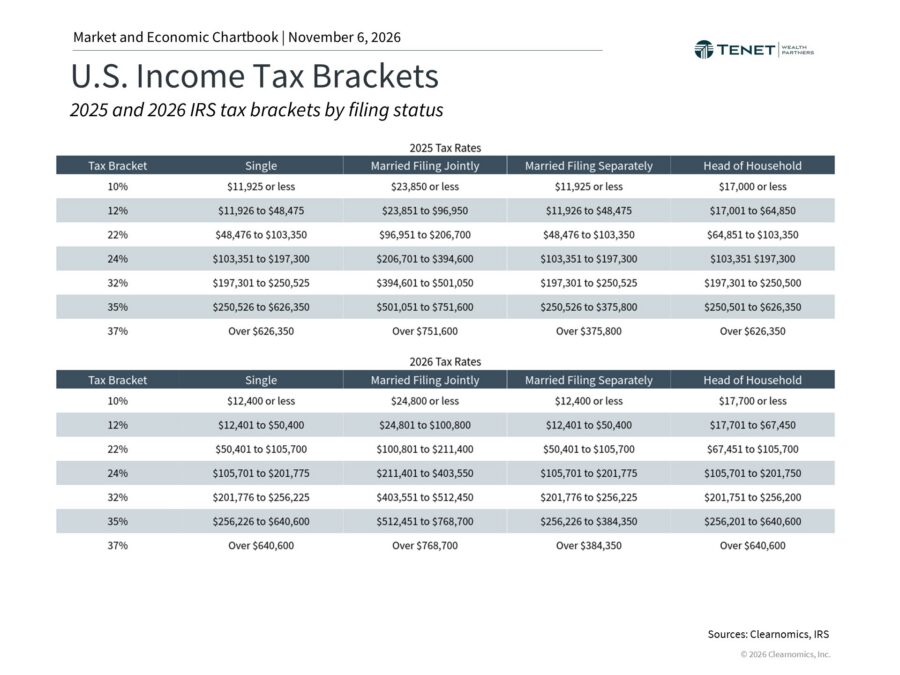
Federal income tax brackets show how ordinary income is taxed at different rates based on taxable income and filing status. Investment income may be taxed differently depending on its source and how long the investment was held.
Source: Clearnomics, U.S. Income Tax Brackets, as of October 16, 2026.
These differences help explain why some investments may be better suited for taxable accounts than others.
Long-term stock holdings and low-turnover exchange-traded funds (ETFs), for example, may generate fewer taxable distributions than investments that regularly produce interest or short-term gains.
Municipal bonds may also be worth considering. Their interest is generally exempt from federal income tax and, depending on the bond and where you live, may also be exempt from state or local taxes.
Taxable accounts can also create planning opportunities, such as tax-loss harvesting or gifting appreciated securities to charity. Whether these make sense depends on your circumstances and current tax rules.
Tax-Deferred Accounts: Managing Taxes Over Time
Traditional IRAs and many employer-sponsored plans, including traditional 401(k)s, allow investments to grow without annual taxes on the earnings inside the account. Depending on the account and your eligibility, contributions may also be made with pre-tax dollars or be tax-deductible.
Taxes are generally paid when money is withdrawn, often in retirement.
That structure can make tax-deferred accounts a useful home for investments that would otherwise produce ongoing taxable income. Examples may include corporate bonds, certain higher-yielding fixed-income investments, and real estate investment trusts (REITs), whose distributions often do not qualify for lower dividend tax rates.
Holding these investments in a tax-deferred account may reduce the annual “tax drag” on your portfolio, allowing more of the earnings to stay invested.
There are tradeoffs to weigh. Withdrawals are generally taxed as ordinary income, and these accounts come with rules around required minimum distributions and potential early withdrawal penalties.3 Future tax rates are also unknown.
Roth Accounts: Potential for Tax-Free Growth
Roth IRAs and Roth accounts within employer plans work differently.
Contributions are made with after-tax dollars, so there is no upfront deduction. In exchange, earnings can grow tax-free, and qualified withdrawals are generally free from federal income tax.
Because of that, some investors consider holding investments with higher long-term growth potential in a Roth account, so any appreciation is not subject to federal income tax when withdrawn under the qualifying rules.
It is worth remembering that higher growth potential usually comes with greater investment risk. Where you place an investment should still reflect your overall strategy, risk tolerance, and time horizon. Roth accounts also have their own eligibility, contribution, and withdrawal rules.4
How Different Investment Accounts Are Taxed
| Account Type | How It’s Generally Taxed | Potential Planning Benefit |
| Taxable brokerage | Interest, dividends, and realized gains may be taxable each year | Flexibility and access to funds |
| Traditional IRA / 401(k) | Tax-deferred growth; withdrawals generally taxed as ordinary income | Deferring taxes on investment earnings |
| Roth IRA / Roth 401(k) | After-tax contributions; qualified withdrawals generally tax-free | Potential for tax-free long-term growth |
Source: Internal Revenue Service. Educational comparison prepared by Tenet Wealth Partners. Account-specific rules and exceptions apply.
How Your Accounts Can Work Together
Rather than looking at each account on its own, it can help to think about how they work together as one portfolio.
A taxable account may provide flexibility and access. A traditional IRA or 401(k) may help manage current taxes on income-producing investments. A Roth account may offer the potential for long-term tax-free growth.
For example, someone who owns both stocks and bonds across several accounts might look at whether some income-producing investments belong in tax-deferred accounts, while more tax-efficient investments stay in a taxable account.
That does not mean every investor should follow the same approach. The right placement depends on factors such as expected returns, tax rates, account balances, risk, and when you expect to draw on each account. An investment that looks tax-efficient in one account may not produce the best after-tax result once future withdrawals and your broader situation are considered.
This is where investment management and tax planning work best when they are coordinated.
Asset Location Is About More Than Taxes
Tax efficiency matters, but it should not come at the expense of flexibility or your other priorities. A thoughtful approach also considers how and when you expect to use your money.
Keeping Money Accessible When You Need It
Some accounts are built mainly for retirement. Others are easier to access.
If you are planning a major purchase, helping a family member, or preparing for the unexpected, having enough accessible assets may matter more than maximizing potential tax savings.
Roth IRAs offer some flexibility, since regular contributions can generally be withdrawn without taxes or penalties. Different rules apply to earnings and certain converted amounts.3 Traditional retirement accounts generally have more restrictions on early withdrawals.
Knowing these differences can help you avoid holding too much of your accessible wealth in accounts that may be difficult or costly to tap.
Planning for Retirement Withdrawals
Asset location can also shape how you approach retirement income.
In retirement, withdrawals from taxable, traditional, and Roth accounts are taxed differently. Selling appreciated investments in a taxable account may create capital gains. Traditional IRA withdrawals generally add to ordinary income. Qualified Roth withdrawals generally do not increase federal taxable income.
Because of this, the order and timing of withdrawals can affect your annual taxes, Medicare premiums, and other parts of your retirement plan.
Some retirees may benefit from drawing on taxable accounts first. Others may find that a mix of withdrawals, Roth conversions, or other strategies fits better. There is no single withdrawal order that works for everyone. What matters is how your accounts work together to support your spending while managing taxes over time.
Coordinating With Your Estate Plan
Where your investments are held can also affect how wealth passes to the next generation.
Under current federal tax rules, appreciated investments held in a taxable account generally receive a step-up in cost basis to fair market value at death, subject to certain exceptions.5 This may reduce the capital gains tax your beneficiaries owe if they later sell.
Inherited retirement accounts follow different rules. Distributions from inherited traditional accounts may be taxable to beneficiaries, while inherited Roth accounts may allow tax-free distributions when the requirements are met.3
That is why beneficiary designations, estate-planning documents, and the types of assets in each account are best reviewed together. The goal is not only to manage taxes today, but to understand how your decisions may affect the people and causes you want to support in the future.
Other Tax-Advantaged Accounts Worth Knowing About
Retirement and brokerage accounts are not the only tools available.
For eligible individuals, Health Savings Accounts (HSAs) may offer three federal tax advantages: tax-deductible or pre-tax contributions, tax-free growth, and tax-free withdrawals for qualified medical expenses.6 If you are able to pay current health care costs from other resources, an HSA may also serve as a longer-term savings vehicle for future medical expenses.
529 education savings plans allow investments to grow tax-deferred, with tax-free withdrawals when used for qualified education expenses under applicable rules.7
Both serve specific purposes, so whether they fit depends on your family’s goals, eligibility, and expected expenses. State tax treatment may also differ from federal treatment.
Revisiting Asset Location as Life Changes
Asset location is not something you set once and forget.
Someone early in their career may focus on long-term growth and tax-efficient saving. Someone nearing retirement may place more weight on liquidity, income, and planning for future withdrawals. Changes in tax law, income, investments, or family circumstances can also shift what makes sense.
There are practical considerations as well. Moving investments between accounts may require selling holdings, which could trigger capital gains taxes, transaction costs, or other consequences. Contribution limits and account rules may also narrow your options.
Asset location also adds some complexity. Holdings spread across several accounts need to be monitored and, at times, rebalanced in a way that keeps both your overall investment mix and the tax picture in view.
For these reasons, asset location decisions are best reviewed as part of an ongoing planning process rather than in response to a single year’s tax bill.
If you are reviewing your own accounts, questions worth considering may include:
- Do you know which of your investments generate the most taxable income each year?
- Are your income-producing investments held in the accounts best suited for them?
- How much of your wealth is accessible if you need it before retirement?
- How do you expect to draw on each account once you stop working?
- Do your beneficiary designations still reflect how your accounts are positioned and who you want to support?
Asset Location: The Bottom Line
Asset allocation helps determine what you own. Asset location adds another layer: where those investments are held.
By coordinating taxable, tax-deferred, and tax-free accounts, investors may be able to improve tax efficiency while keeping an investment strategy aligned with their goals. But the right approach depends on more than tax rates. Your cash-flow needs, retirement timeline, estate-planning priorities, and long-term objectives all play a role.
If you have investments spread across several accounts, your Tenet Wealth Partners advisor can help you review how they are positioned and how those choices fit alongside the other pieces of your financial plan, working with your tax professional where appropriate.
The goal is not simply to pay less in taxes this year. It is to make thoughtful decisions that help your wealth support what matters most to you.
References
- Internal Revenue Service, Topic No. 409, Capital Gains and Losses.
- Internal Revenue Service, Federal Income Tax Rates and Brackets; Internal Revenue Bulletin 2025-45 (2026 inflation adjustments).
- Internal Revenue Service, Publication 590-B, Distributions from Individual Retirement Arrangements (IRAs).
- Internal Revenue Service, Publication 590-A, Contributions to Individual Retirement Arrangements (IRAs).
- Internal Revenue Service, Publication 559, Survivors, Executors, and Administrators.
- Internal Revenue Service, Publication 969, Health Savings Accounts and Other Tax-Favored Health Plans.
- Internal Revenue Service, Publication 970, Tax Benefits for Education.
See How Your Accounts Work Together
Where you hold your investments can affect your taxes, your flexibility, and what you eventually pass on. Tenet can help you review how your accounts fit together and coordinate with your tax professional.
No pressure. Just a conversation about your financial plan.

Investment advisory services offered through Tenet Wealth Partners, LLC, a registered investment advisor with the U.S. Securities and Exchange Commission. This material is intended for informational purposes only. It should not be construed as legal or tax advice and is not intended to replace the advice of a qualified attorney or tax advisor. This information is not an offer or a solicitation to buy or sell securities. The information contained may have been compiled from third-party sources and is believed to be reliable.
The information provided in this communication was sourced by Tenet Wealth Partners through public information and public channels and is in no way proprietary to Tenet Wealth Partners, nor is the information provided Tenet Wealth Partner’s position, recommendation or investment advice.
This material is provided for informational/educational purposes only. This material is not intended to constitute legal, tax, investment or financial advice. Investments are subject to risk, including but not limited to market and interest rate fluctuations.
Any performance data represents past performance which is no guarantee of future results. Prices/yields/figures mentioned herein are as of the date noted unless indicated otherwise. All figures subject to market fluctuation and change. Additional information available upon request.
About The Author
Kyle Wetters, CFP®Co-Founder & Managing Partner
Kyle Wetters co-founded Tenet Wealth Partners in 2021, intent on putting his client’s interests above all else. As a CERTIFIED FINANCIAL PLANNER® practitioner, with over 20 years of experience in the financial industry, he specializes in retirement planning for his clients. Kyle listens to his customers’ goals and values to develop long-term strategic plans to […]
Learn more about Kyle