Artificial intelligence has quickly moved from an emerging technology to an everyday tool. A chatbot can answer a question, summarize a document, or create an image within seconds. The interaction may feel simple, but the system that makes it possible is anything but.
Behind every prompt is an extensive network of semiconductors, servers, data centers, electricity, cooling systems, software, and ongoing investment. This broader view is important because AI is not represented by a single company or type of investment. It is a developing value chain that reaches across industries, each with its own characteristics and risks.
For investors, that distinction matters. AI has the potential to reshape how businesses operate and how certain industries develop, but determining where lasting economic value will emerge is much more difficult. Understanding the infrastructure behind AI, the amount of capital being invested, and the expectations already reflected in markets can provide useful perspective as the technology continues to develop.
Understanding the AI Value Chain
Semiconductors form the foundation of the AI value chain. Advanced processors and memory chips provide the computing resources needed both to build large language models and to operate them once they are available to users.
Developing a model involves training it with significant amounts of data across connected servers. This process can require substantial time and computing capacity. Once a model is deployed, each user request creates additional demand through a process known as inference, when the trained model applies what it has learned to generate a response.
Training and inference create different types of computing demand, but both depend on sophisticated hardware. This has made semiconductor manufacturers and other parts of the hardware supply chain an important part of the AI investment story.
The infrastructure extends well beyond the chips themselves.
Processors and servers must be housed in data centers designed to operate continuously. These facilities require electricity, cooling, networking equipment, security, and ongoing maintenance. Expanding capacity can also require new construction, additional power infrastructure, and significant capital investment.
As AI use has grown, investment in data centers and related infrastructure has accelerated alongside demand for computing capacity. Not all of that demand is attributable solely to AI. Businesses were already increasing their reliance on cloud computing, automation, and digital services. AI has added another significant source of demand for computing resources.
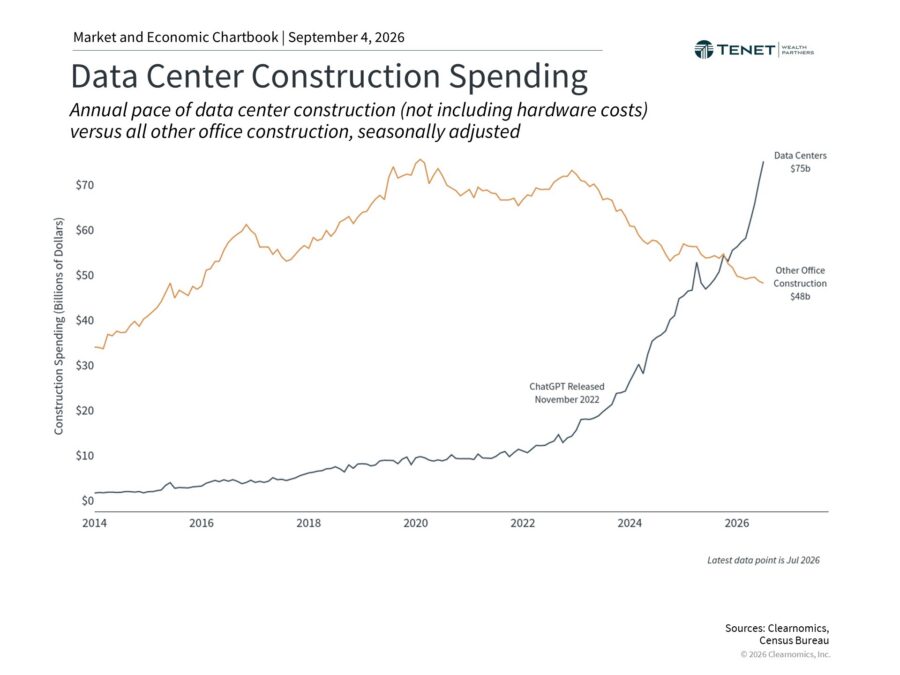
The value chain continues through cloud providers and software companies and ultimately reaches the businesses putting AI to work.
This may be one of the more difficult parts of the AI story to evaluate. A company can have access to powerful technology without necessarily creating economic value from it. Over time, the question will be whether businesses can use AI to improve productivity, strengthen products and services, manage costs, or develop new sources of revenue.
In other words, building AI is only one part of the equation. How effectively businesses use it may ultimately be just as important.
Where Economic Value May Emerge
As the technology develops, investors may also need to consider how value is created further along the AI value chain.
Much of the attention today is focused on the companies providing the computing power and infrastructure necessary to support AI. These businesses are benefiting from the investment required to build and expand capacity.
But infrastructure is only one part of the picture. Software providers are incorporating AI into existing products, while businesses across industries are considering how the technology could improve their operations, customer experiences, and decision-making.
This creates an important distinction for investors: widespread adoption of AI does not automatically translate into attractive investment returns for every company associated with the technology.
A business may participate in a growing market but still face increased competition, rising costs, pressure on profit margins, or difficulty turning adoption into sustainable earnings. The price investors pay also matters. Even strong business results can produce disappointing investment outcomes if expectations were already too high.
For investors, it can therefore be useful to separate two questions: How important might AI become to the economy, and which businesses may be able to turn that adoption into lasting financial results?
The answers may not always be the same.
Weighing Investment Against Future Results
The scale of spending on AI infrastructure raises another important question: Will the eventual financial results justify the amount being invested today?
Building the capacity needed to develop and operate AI models requires substantial upfront investment. Demand for computing power has supported semiconductor manufacturers, data-center operators, and other infrastructure providers. Large technology companies are also directing significant capital toward expanding their AI capabilities.
For those investments to create lasting economic value, companies eventually need to generate sufficient benefits from them. Those benefits could take the form of additional revenue, stronger products, greater productivity, lower costs, or a combination of these outcomes.
There is also another variable to consider: efficiency.
As AI models and supporting technology improve, they may require fewer computing resources to perform a given task. At first glance, that could appear to reduce future demand for infrastructure.
Greater efficiency, however, does not necessarily mean lower overall usage. When a technology becomes less expensive and more capable, people and businesses may begin using it more frequently or applying it in ways that were not previously practical.
This idea is often described through the Jevons paradox: improvements in efficiency can reduce the resources needed for an individual use while encouraging enough additional usage that overall demand continues to grow.
AI could experience a similar dynamic. If performing AI-assisted tasks becomes faster and less expensive, businesses may incorporate the technology into more processes. Lower computing requirements for an individual task would therefore not necessarily translate into lower overall demand for computing resources.
Whether that occurs, and at what scale, remains uncertain. Adoption, efficiency, infrastructure constraints, competition, and new applications will all influence how demand develops.
Keeping Expectations in Perspective
New technologies have often created periods when long-term economic potential and near-term investor expectations become difficult to separate.
The internet offers a useful example. It ultimately changed commerce, communication, media, and many other parts of the economy. Yet during its early development, markets often struggled to determine which companies would succeed and how quickly the economic opportunity would translate into sustainable profits. As with many past technological transformations, the internet produced both significant winners and substantial losses for investors.
AI does not need to follow the same path for the lesson to remain relevant.
Investors can be right about the importance of a technology without knowing which businesses will capture the most value, how quickly profits will develop, or what price represents an appropriate investment.
That distinction becomes particularly important when expectations are elevated.
Enthusiasm surrounding AI has contributed to higher valuations across parts of the technology sector. Strong earnings may support some of those prices, but valuations also reflect expectations about future growth. When expectations are high, companies may need to continue delivering strong results simply to meet what investors have already priced into their shares.
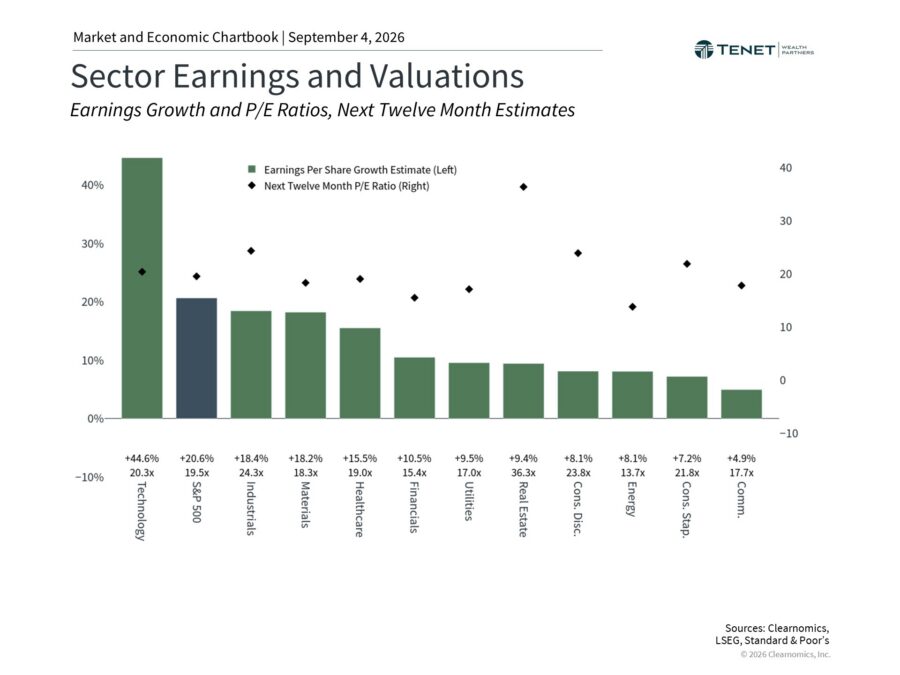
Slower adoption, increased competition, lower-than-expected returns on AI spending, or other disappointments can therefore contribute to greater volatility.
Valuations cannot tell investors what markets will do tomorrow. They can provide context for understanding how much optimism may already be reflected in current prices and whether a particular investment still makes sense within a broader portfolio.
An important principle applies here: a strong company is not automatically an attractive investment at every price.
Understanding the AI Exposure You May Already Have
Investors interested in AI may naturally consider whether they should add a specialized technology or AI-focused investment to their portfolios. Before doing so, it can be useful to understand how much exposure may already be present.
Many broadly diversified U.S. stock funds hold large technology companies that are investing heavily in AI or providing the infrastructure behind it. Businesses outside the technology sector are also increasingly adopting AI within their operations.
As a result, an investor may already participate in the growth of AI through existing holdings without owning a fund or stock selected specifically for that theme.
Adding a specialized investment can increase that exposure, but it can also create greater concentration in companies or sectors that may already represent a meaningful portion of the portfolio. Concentration in individual securities or sectors can increase portfolio volatility.
This is where looking at the portfolio as a whole becomes important. The question is not simply whether AI has attractive long-term potential. It is also whether additional exposure supports the investor’s desired balance of risk, diversification, and long-term objectives.
Keeping AI Within the Broader Plan
AI may continue to influence financial markets and the broader economy for years to come. Its impact could eventually extend well beyond the companies currently associated most closely with the technology.
The outcomes will likely vary considerably across companies and industries. Hardware providers may benefit from infrastructure spending. Data centers and other supporting businesses may benefit from greater computing demand. Software companies may develop new applications. Businesses across the economy may find ways to become more productive.
At the same time, expectations will continue to change as investors receive new information about adoption, spending, competition, and profitability.
For long-term investors, this makes perspective especially important.
Rather than trying to identify every potential winner, it can be more useful to consider how exposure to AI fits alongside the rest of the portfolio. Diversification can provide exposure across different companies, sectors, and potential sources of return without requiring a portfolio to depend too heavily on a single theme developing exactly as expected.
Transformational themes can be part of a long-term investment strategy without becoming the entire strategy.
Maintaining diversification, considering valuation, understanding existing exposure, and keeping investment decisions connected to long-term financial goals remain important as the AI value chain continues to develop.
If you have questions about how broader market themes, including AI, fit within your long-term plan and diversified portfolio, we’re here to talk.
Put AI Investing in the Context of Your Full Portfolio
Emerging investment themes can create both opportunities and new risks. A broader portfolio review can help you understand your existing exposure, diversification, and how new investments fit within your long-term financial plan.
No pressure. Just a conversation about your financial plan.

Investment advisory services offered through Tenet Wealth Partners, LLC, a registered investment advisor with the U.S. Securities and Exchange Commission. This material is intended for informational purposes only. It should not be construed as legal or tax advice and is not intended to replace the advice of a qualified attorney or tax advisor. This information is not an offer or a solicitation to buy or sell securities. The information contained may have been compiled from third-party sources and is believed to be reliable.
The information provided in this communication was sourced by Tenet Wealth Partners through public information and public channels and is in no way proprietary to Tenet Wealth Partners, nor is the information provided Tenet Wealth Partner’s position, recommendation or investment advice.
This material is provided for informational/educational purposes only. This material is not intended to constitute legal, tax, investment or financial advice. Investments are subject to risk, including but not limited to market and interest rate fluctuations.
Any performance data represents past performance which is no guarantee of future results. Prices/yields/figures mentioned herein are as of the date noted unless indicated otherwise. All figures subject to market fluctuation and change. Additional information available upon request.
About The Author
Kevan Melchiorre, CFP®Co-Founder & Managing Partner
Kevan Melchiorre co-founded Tenet Wealth Partners in 2021 with a focus on delivering a premier client experience, supported by an innovative and fully integrated approach to wealth planning. As a CERTIFIED FINANCIAL PLANNER® practitioner with over 18 years of wealth management experience, Kevan partners with affluent individuals, families, and institutions to help align their capital […]
Learn more about Kevan